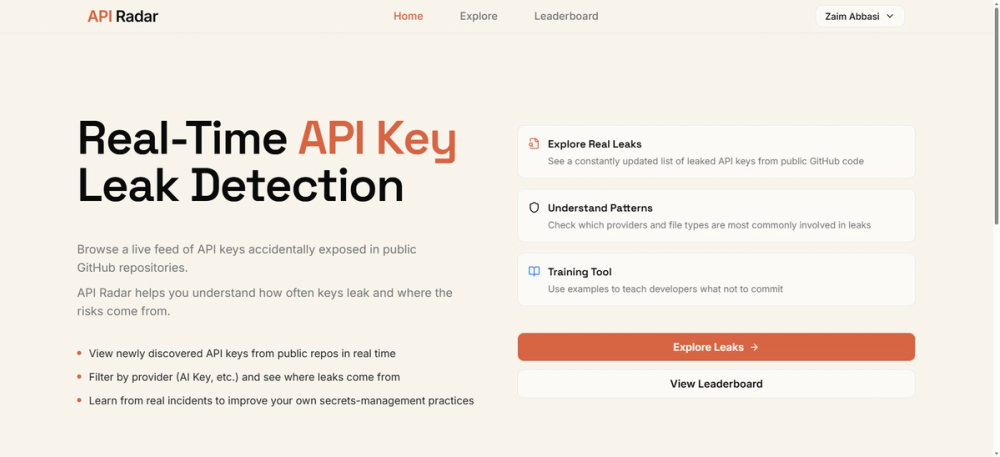
See your leaked API keys before attackers do
API Radar is a real-time detection and tracking platform designed to identify API key leaks discovered in public GitHub repositories. It continuously monitors millions of GitHub repositories to find and catalog exposed credentials, helping developers and security teams stay aware of potential security risks. The platform provides detailed information about each leak, including the provider, redacted key preview, repository path, and detection timestamp, making it an essential tool for maintaining code security hygiene.
Getting started with API Radar is straightforward and requires no setup or installation.
1. Visit the Platform Navigate to the API Radar website and access the main dashboard where you can explore recent API key leaks.
2. Browse Recent Leaks Use the Home section to view the latest detected leaks from public GitHub repositories with redacted key previews.
3. Explore and Filter Head to the Explore section to filter and sort leaked credentials by various criteria such as provider, file type, and programming language.
4. Analyze Patterns Review the data insights to understand which providers are most commonly compromised and identify leak patterns.
5. Check the Leaderboard Visit the Leaderboard to see statistics about which API providers have the most exposed credentials.
6. Educate Your Team Use the real-world examples from API Radar to train your development team on proper secrets management and safe code committing practices.
Real-Time Leak Detection Monitors millions of public GitHub repositories continuously to identify and catalog exposed API credentials as they are discovered.
Comprehensive Leak Details Provides essential information for each leak including provider identification, redacted key preview, repository name, file path, and detection timestamp.
Advanced Filtering and Sorting Offers powerful filtering capabilities to sort leaked credentials by provider, file type, programming language, and other criteria.
Direct Source Links Includes clickable links to the exact commits and files where leaks were detected, enabling quick verification and response.
Pattern Analysis Delivers insights into which API providers are most commonly compromised and helps identify trends in credential exposure.
Team Training Resource Serves as an educational platform with real-world examples for teaching developers about secrets hygiene and secure coding practices.
#1 Security Auditing Security teams can use API Radar to monitor for exposed credentials related to their organization, enabling quick response to potential breaches before malicious actors exploit them.
#2 Developer Education Development leads and security trainers can leverage real-world leak examples to educate teams about the importance of proper secrets management and avoiding hardcoded credentials.
#3 Compliance Monitoring Organizations with regulatory requirements can use API Radar as part of their security monitoring toolkit to demonstrate due diligence in protecting sensitive credentials.
#4 Security Research Security researchers and analysts can study leak patterns and trends to better understand common mistakes developers make when handling API keys.
#5 Pre-Commit Verification Development teams can reference API Radar to understand what types of secrets commonly get leaked, helping them configure pre-commit hooks and security scanning tools more effectively.
What is API Radar and how does it work? API Radar is a real-time monitoring platform that scans public GitHub repositories to detect exposed API keys and credentials. It catalogs these leaks with detailed information including the provider, redacted key preview, file path, and timestamp, helping developers and security teams stay informed about potential security risks.
Is API Radar free to use? Yes, API Radar is currently free to use. The platform allows you to browse and explore leaked credentials without any cost. Future features like private monitoring for organizations may be offered as premium options.
Should I use the exposed credentials I find on API Radar? No, absolutely not. API Radar explicitly states that the credentials are provided for awareness purposes only. Misusing exposed credentials is illegal and unethical. The platform is designed for security awareness and education, not for exploitation.
What future features are planned for API Radar? The platform has announced plans to add more provider support, trend views for analyzing leak patterns over time, and optional private monitoring capabilities for organizations that want to track their own credential exposure.
How can API Radar help my development team? API Radar serves as an excellent educational resource showing real-world examples of credential leaks. Teams can use it to understand common mistakes, improve their secrets management practices, and configure better security measures in their CI/CD pipelines.